

National Gathering of Graduate Students
Event Archive
October 27-30 2025, Banff, Alberta
NGGS 2025 brings Indigenous graduate students from across the country together in Banff to share research, build community, and connect through mentorship. Over four days at the Banff Centre for Arts and Creativity, students gather for presentations, themed circles, and conversations that support their work in Indigenous health and well-being.
Hosted by the IPHCPR Network, the gathering offers space for peer exchange, guidance from leaders in Indigenous health, and collective reflection on research practices shaped by identity, ethics, and relational ways of knowing. The program includes a keynote by Dr. Leroy Little Bear, peer mentorship circles, off-site activities, and evening gatherings that make room for culture, creativity, and shared learning.
Explore research posters presented at this year’s gathering!
Additional posters will be uploaded as they become available.
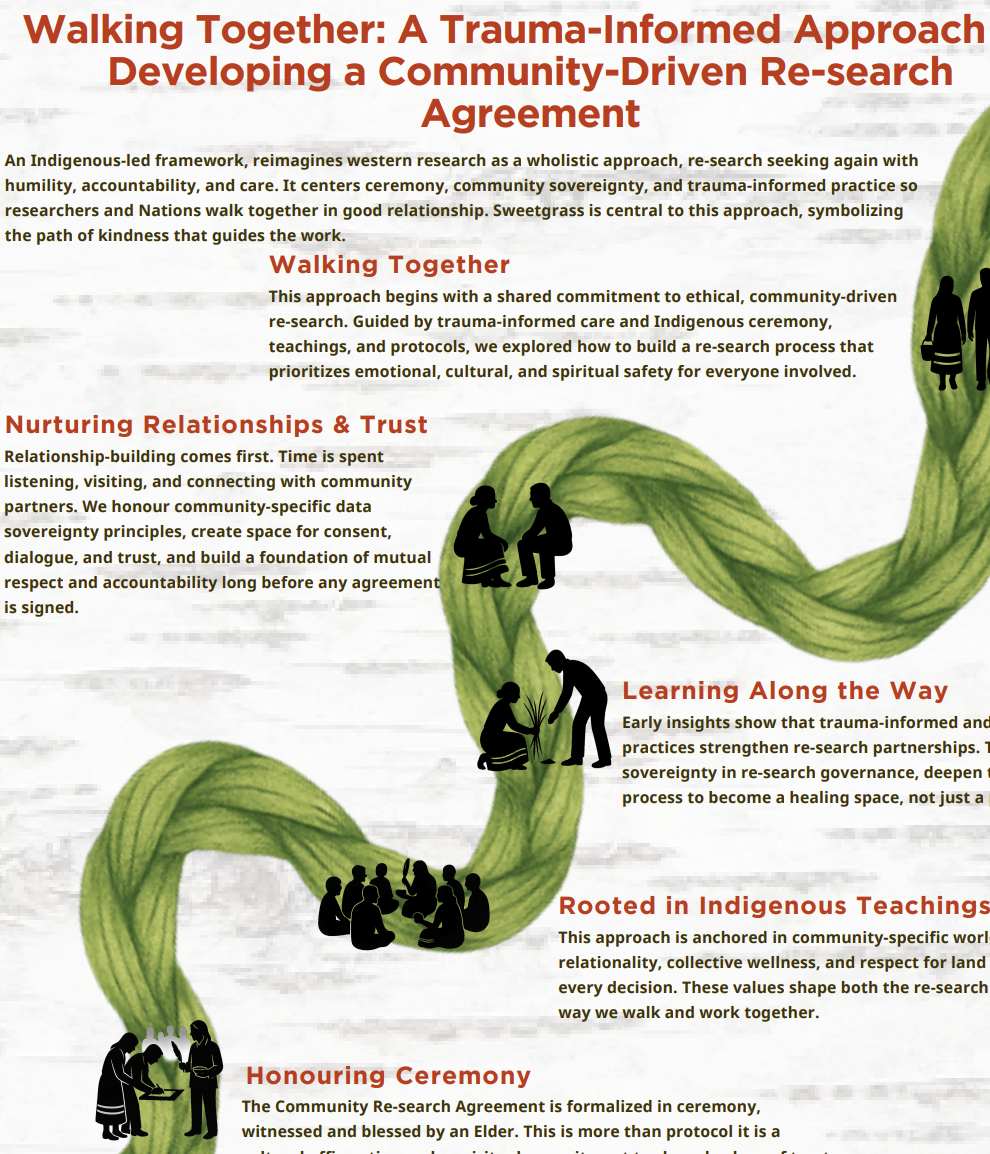
Walking Together: A Trauma-Informed Approach to Developing a Community-Driven Research Agreement
Alison Elsner,
University of Saskatchewan, College of Medicine
About: Outlines an Indigenous-led approach to creating a community-driven research agreement shaped by ceremony, relational practice, and trauma-informed care. The work focuses on relationship-building, community sovereignty, and cultural safety, with trust developed through time spent listening, visiting, and connecting. Early insights show that grounding research governance in Indigenous teachings and ceremony strengthens partnerships and supports a more accountable, healing-focused research process.
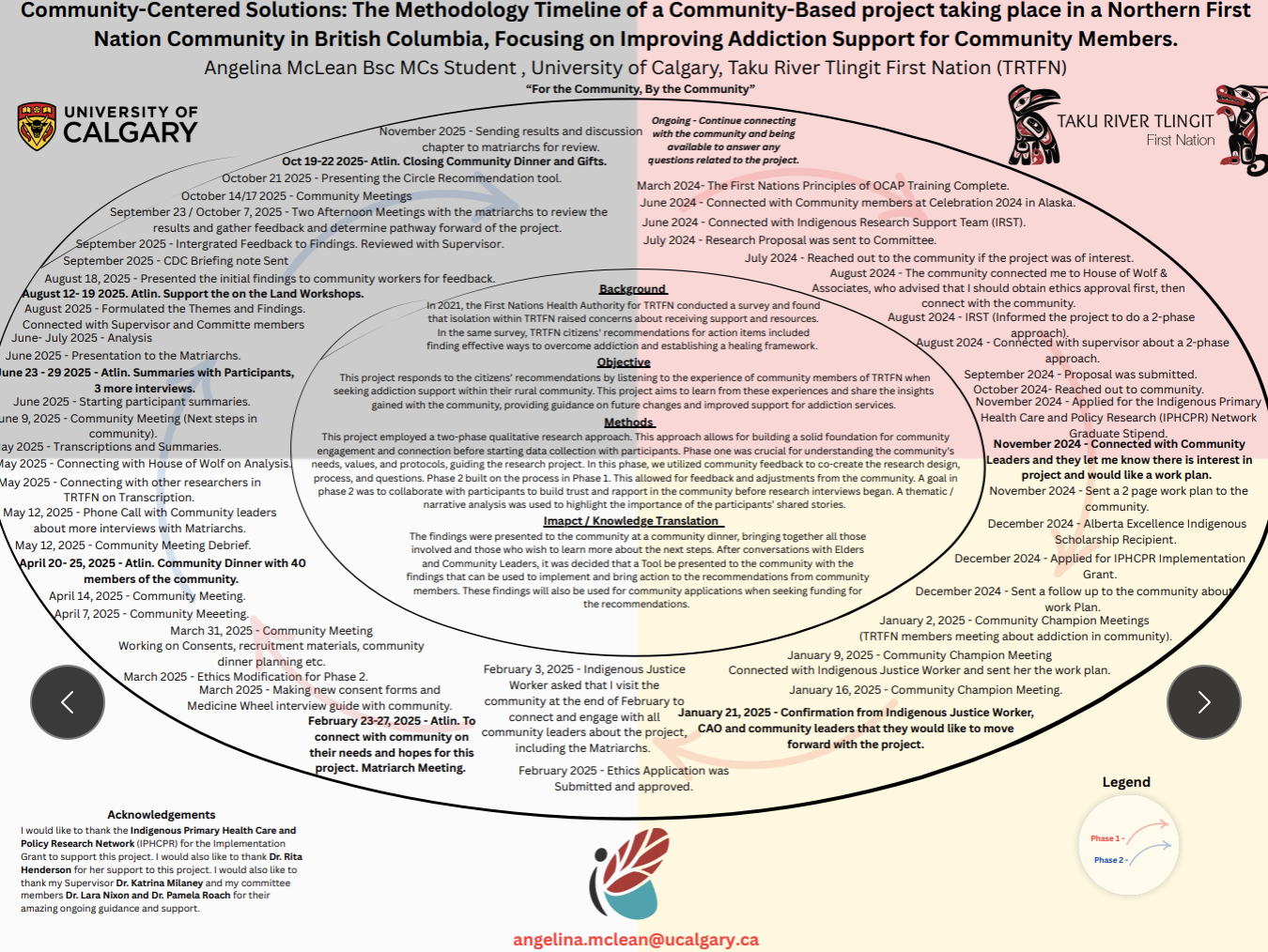
Community-Centred Solutions: Methodology Timeline of a Community-Based Project in a Northern First Nation
Angelina McLean, University of Calgary; Taku River Tlingit First Nation
About: Maps a two-phase community-driven project designed with Taku River Tlingit First Nation to strengthen addiction support. Phase 1 focused on relationship-building, listening, and co-developing the research design with community members, matriarchs, and leaders. Phase 2 continued this collaboration through meetings, on-the-land visits, community dinners, and iterative feedback on emerging findings. The project illustrates how sustained engagement, shared decision-making, and narrative methods can guide responsive, culturally grounded improvements to addiction services.
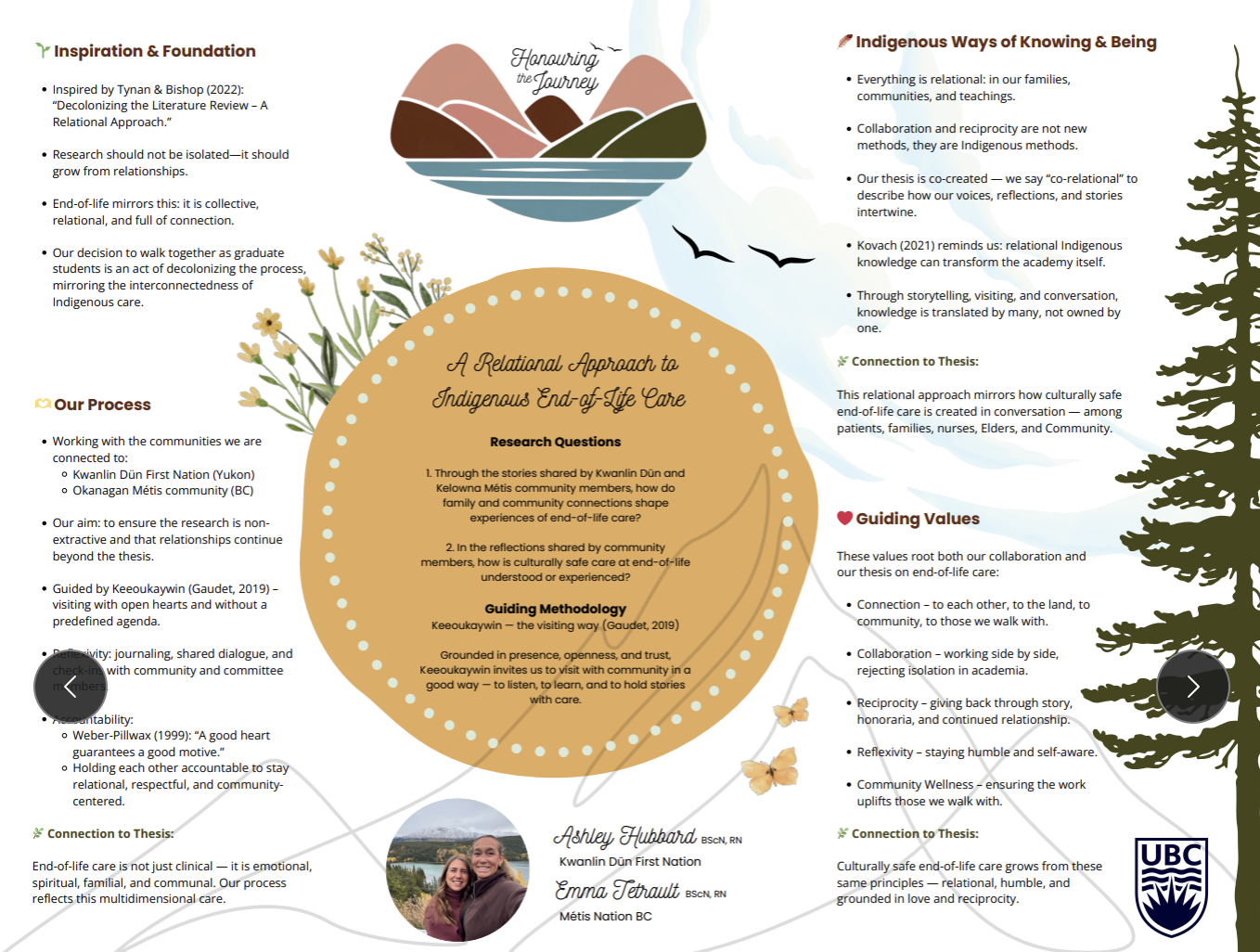
A Relational Approach to Indigenous End-of-Life Care
Ashley Hubbard; Emma Tetrault University of British Columbia
About: Explores a co-created thesis project shaped through visiting, storytelling, and continued dialogue with Kwanlin Dün First Nation and the Okanagan Métis community. Guided by Keeoukaywin, the visiting way, the work examines how family and community relationships influence experiences of end-of-life care. The project reflects a shared research process grounded in reciprocity, humility, and ongoing connection, illustrating how culturally safe end-of-life care emerges through relational practice rather than clinical procedure alone.
Évaluation de l’adéquation des services du Havre du Fjord pour les jeunes autochtones et allochtones
Carole-Anne Néron; Louise Carignan; Fatoumata Diadiou
About: Investigates whether services offered at Le Havre du Fjord meet the needs of youth, with particular attention to culturally grounded supports for Indigenous participants. Using a qualitative design involving interviews with young people and multidisciplinary staff, the research examines access barriers, cultural safety, and the relevance of current programming. Findings are intended to guide concrete service improvements, support culturally informed practices, and strengthen inclusive approaches for youth in vulnerable situations. [Translated from French]

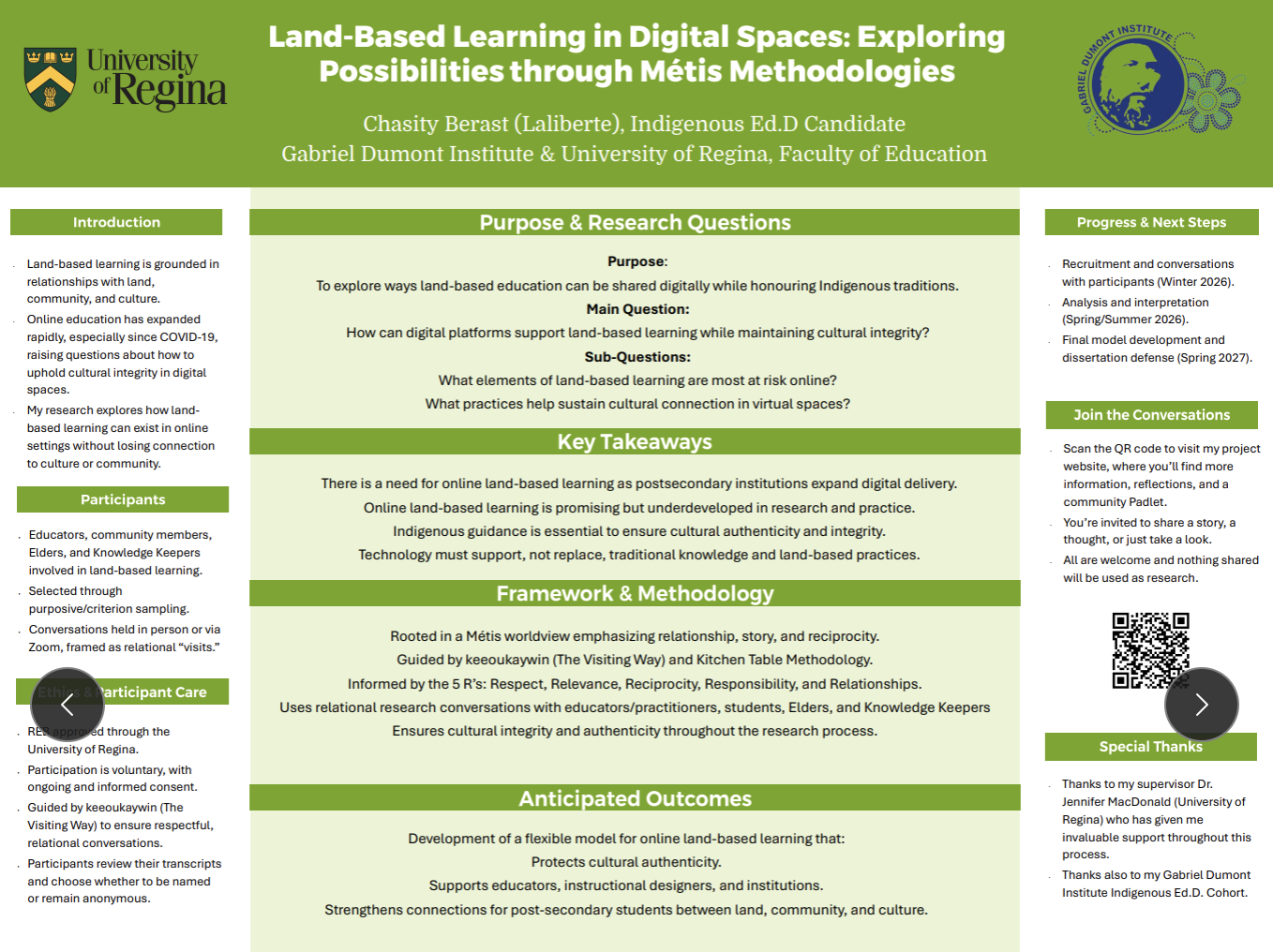
Land-Based Learning in Digital Spaces: Exploring Possibilities through Métis Methodologies
Chasity Berast (Laliberte), Gabriel Dumont Institute & University of Regina
About: Investigates how land-based education can move into digital environments while maintaining cultural integrity. Guided by Métis methodologies, keeoukaywin, and the 5 R’s, the project draws on conversations with educators, Elders, Knowledge Keepers, and community members. Early insights point to strong interest in online land-based learning, the need for Indigenous leadership in its design, and the importance of technology supporting, not replacing, relationships to land, community, and culture. Anticipated outcomes include a flexible model to help institutions and instructors sustain authentic cultural connection in virtual spaces
Skicin Tepuwikhasit Nutsihpiluwet Wihqimut naka Menuwehkuhut: Waponakey Eli Nomihatsik /
Indigenous Registered Nurse Recruitment and Retention: A Waponahki Perspective
Jasmine Murchison-Perley, University of New Brunswick
About: Examines how Indigenous Registered Nurses in New Brunswick experience recruitment, retention, and professional support, grounded in Waponahki knowledge and relational accountability. Sharing Circles, ceremony, and Elder guidance shape the methodological approach, allowing nurses to speak to barriers rooted in colonial legacies as well as the conditions that foster belonging, safety, and resilience in health and education systems. The project contributes insight toward more equitable nursing policy, culturally responsive workplace environments, and stronger pathways for Indigenous nurses across their training and careers.

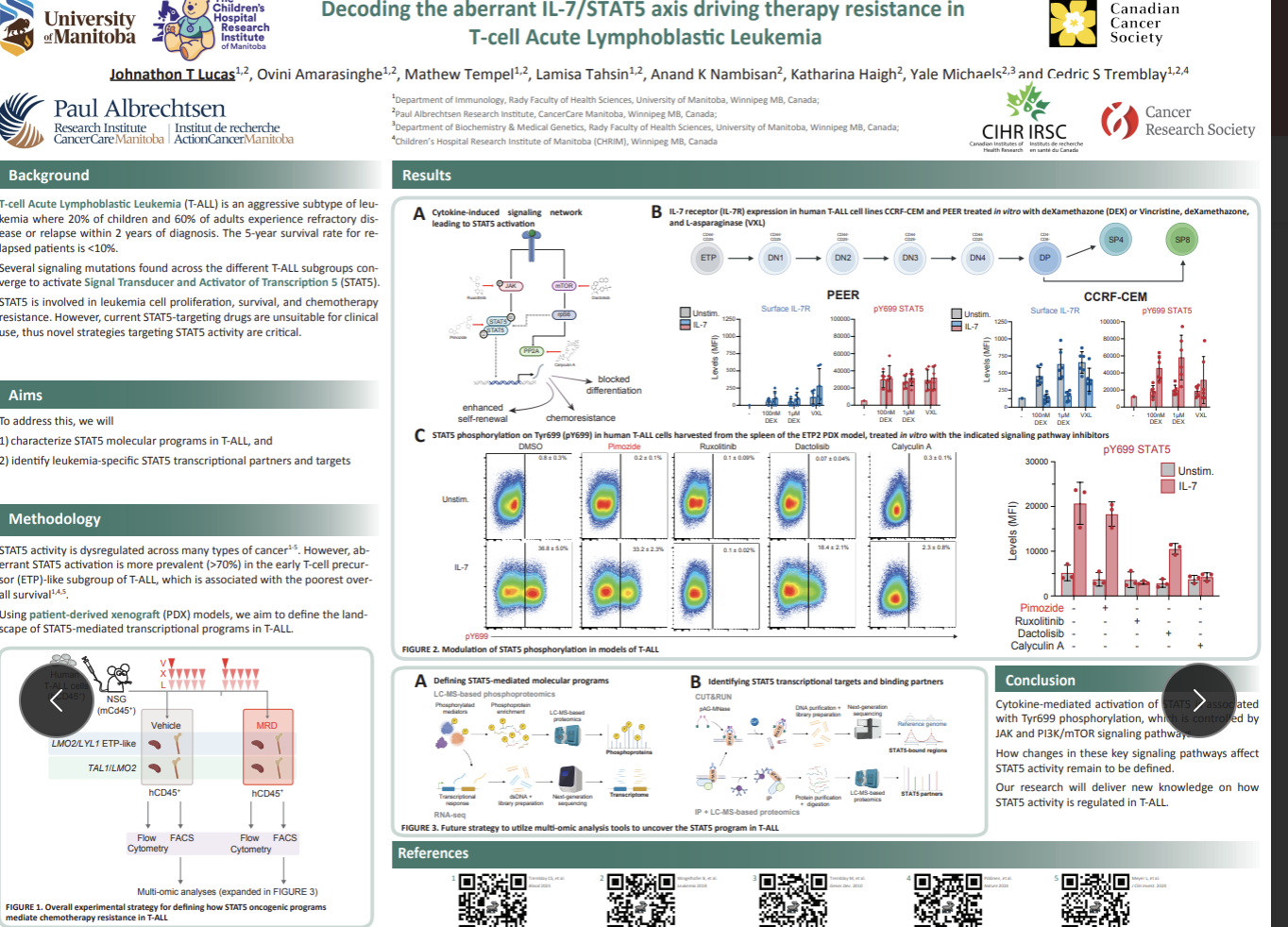
Decoding the aberrant IL-7/STAT5 axis driving therapy resistance in T-cell Acute Lymphoblastic Leukemia
Johnathon T. Lucas; Ovini Amarasinghe; Mathew Tempel; Lamisa Tahsin; Anand K. Nambisan; Katharina Haigh; Yale Michaels; Cedric S. Tremblay, University of Manitoba
About: Examines how dysregulated IL-7/STAT5 signalling contributes to chemotherapy resistance in T-ALL, with particular relevance for the high-risk ETP-like subgroup where STAT5 activation is especially prevalent. Using patient-derived xenograft models and multi-omic approaches, the project maps STAT5 phosphorylation dynamics, defines associated transcriptional programs, and identifies potential leukemia-specific targets. The work aims to inform new therapeutic strategies by clarifying how key signalling pathways regulate STAT5 activity in aggressive T-ALL.
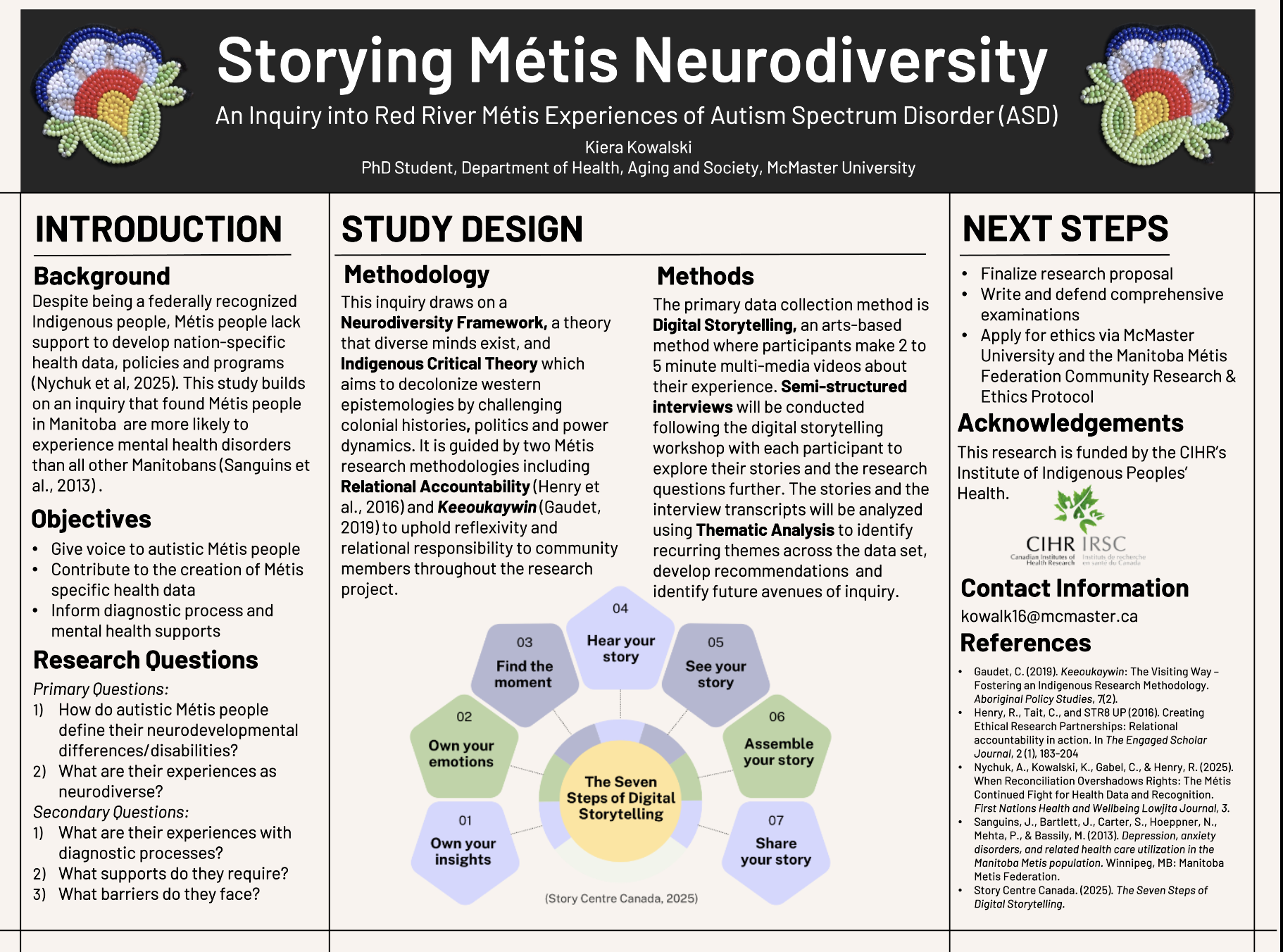
Storying Métis Neurodiversity: An Inquiry into Red River Métis Experiences of Autism Spectrum Disorder
Kiera Kowalski, McMaster University
About: Examines how autistic Métis people understand their neurodevelopmental differences and navigate diagnostic processes, supports, and barriers. Guided by Métis research methodologies such as Relational Accountability and Keeoukaywin, the project uses digital storytelling and interviews to document lived experience and generate community-rooted insight. The work responds to longstanding gaps in Métis-specific health data and aims to inform more culturally grounded mental health and diagnostic supports for Métis communities
Socioeconomic Inequalities in Chronic Diseases Among Off-Reserve Indigenous Populations in Canada, 2001–2022
Kylie Curnew; Mohammad Hajizadeh; George Kephart; Debbie Martin; Lindsay Wallace
Dalhousie University
About: Examines two decades of socioeconomic inequality in chronic disease prevalence among First Nations (off-reserve), Métis, and Inuit adults using repeated cycles of the Indigenous Peoples Survey. The analysis quantifies inequality, identifies how its drivers have shifted over time, and considers the protective influence of cultural strengths such as language, traditional activities, and land connection. Findings point to persistent disparities shaped by colonial structures and socioeconomic conditions, while highlighting the role of culturally grounded strengths and Indigenous data sovereignty in guiding future health policy and research.

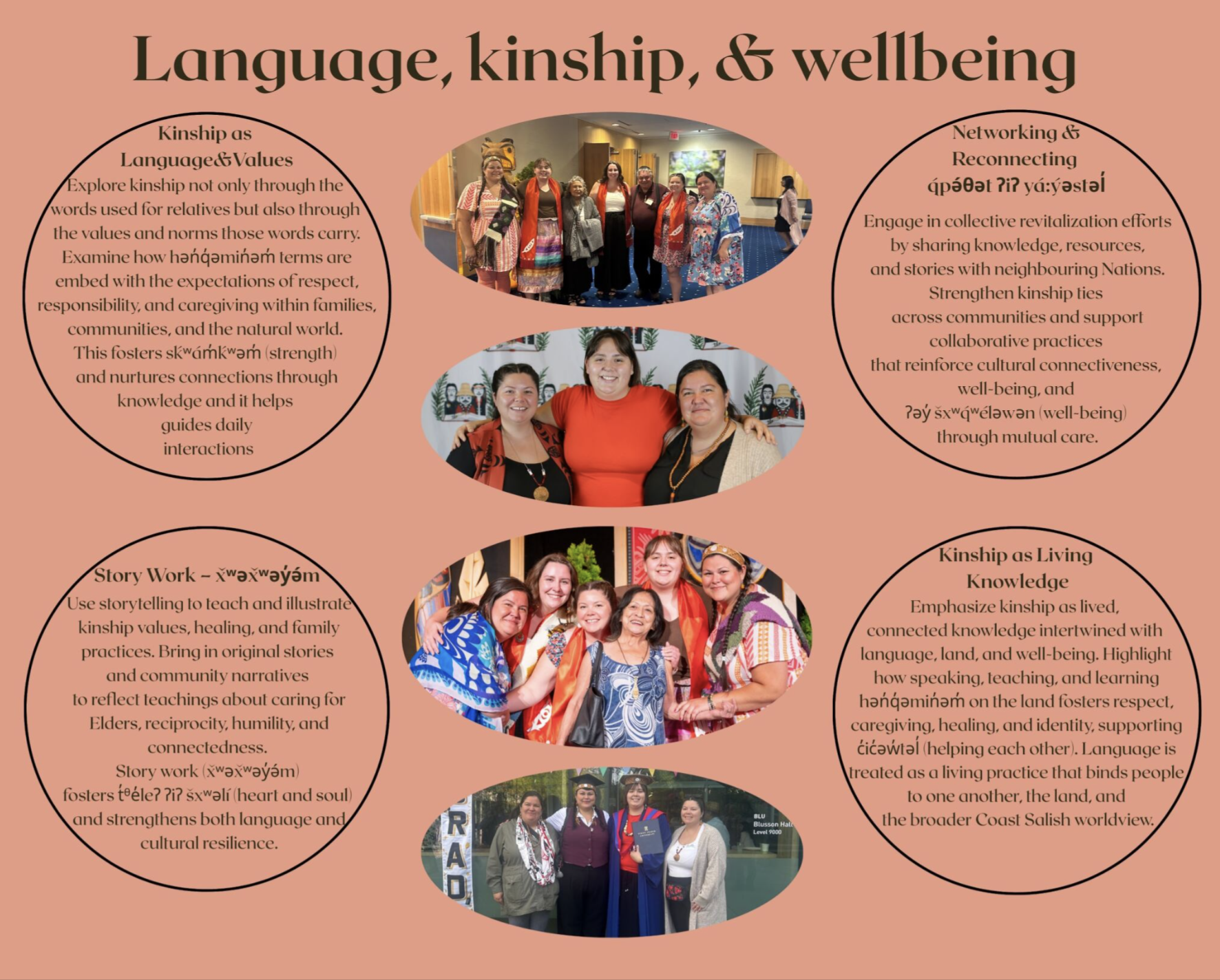
Language, Kinship, & Wellbeing
Lilly Cunningham
About: Examines how kinship, language, and cultural practices shape wellbeing within Coast Salish communities. The poster brings forward four interrelated teachings: kinship as language and values, kinship as lived knowledge, story work as a pathway for teaching and healing, and the role of networking with neighbouring Nations in strengthening cultural connection. Together, these teachings show how relational practices, reciprocal care, and language revitalization foster resilience, belonging, and holistic wellbeing across families and communities.
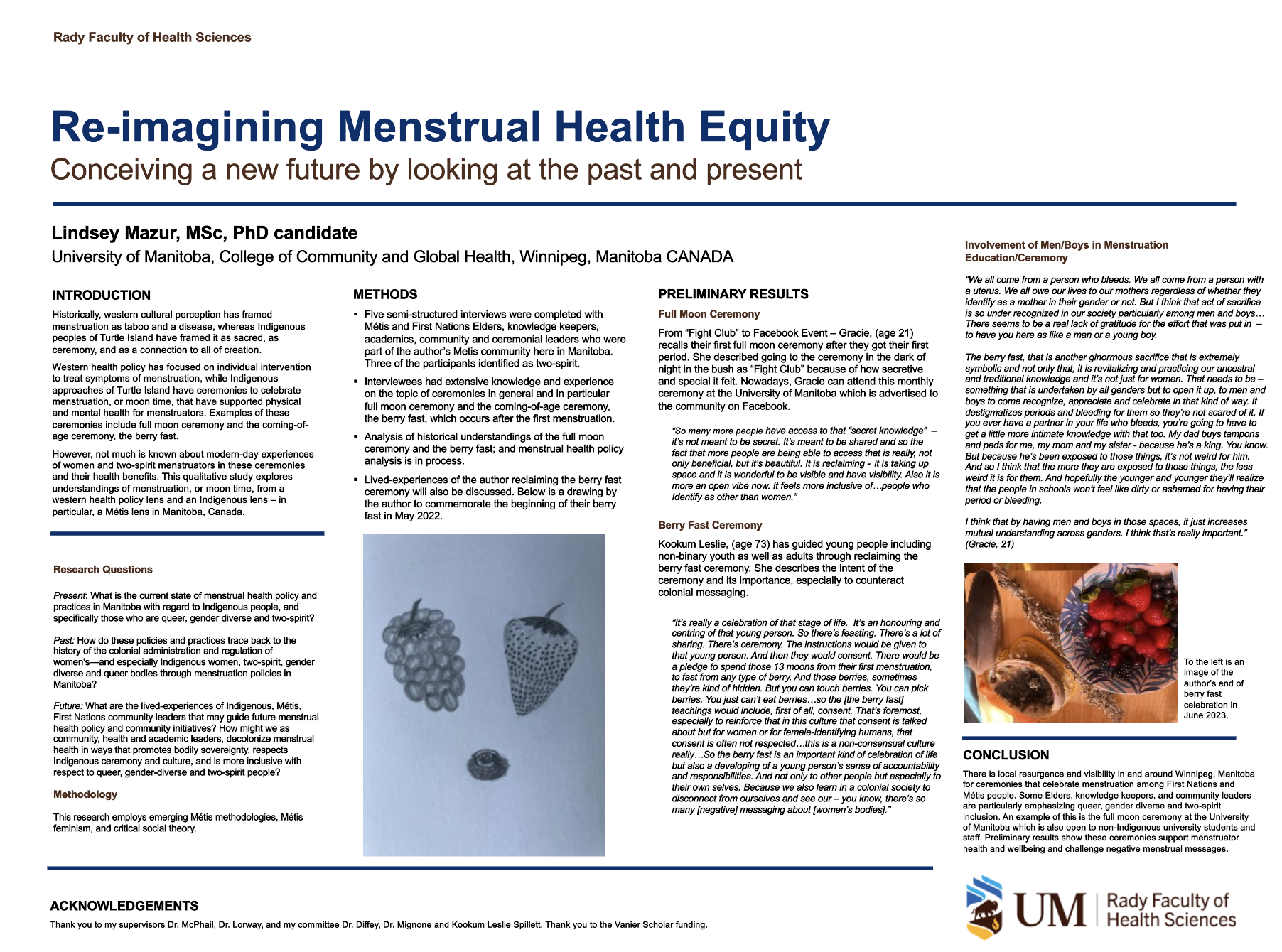
Re-imagining Menstrual Health Equity: Conceiving a New Future by Looking at the Past and Present
Lindsey Mazur, University of Manitoba, College of Community and Global Health
About: Explores menstrual health through Métis and First Nations teachings alongside the colonial policies that shaped contemporary understandings of menstruation in Manitoba. Drawing on interviews with Elders, knowledge keepers, ceremonial leaders, and two-spirit participants, the study examines full moon and berry fast ceremonies as sources of wellbeing, consent teaching, community connection, and cultural resurgence. Early findings show growing visibility of menstrual ceremony in Winnipeg and highlight inclusive approaches that support menstruators of all genders while challenging harmful colonial narratives.
Voices of Wellbeing: Indigenous Artists’ Directions Toward Arts-based Mental Health Interventions
Sarah Boyer, McGill University; Concordia University
About: Centres Indigenous artists’ insights on how art-making and art-teaching practices contribute to community and individual well-being. Through literature review, knowledge-exchange gatherings, and co-creation workshops in Montréal, the project examines culturally grounded approaches that integrate ceremony, material culture, and relational creative processes. The work aims to strengthen the development of culturally relevant arts-based mental health interventions informed by Indigenous expertise and experience.

The Wholistic Care: Impact of the Positive Living Program among 2-Spirit, Indigiqueer and Transgender People Living with HIV in Ontario
Shiva Acharya, Laurentian University
About: Examines a longitudinal HIV testing, treatment linkage, and support initiative developed by 2-Spirited People of the 1st Nations during the COVID-19 pandemic. Survey findings from 2021 and 2025 show that meeting immediate needs—food, shelter, transportation, hygiene, technology access, and culturally grounded mental health support—significantly increases service use among 2-Spirit, Indigiqueer, and transgender participants. The Positive Living Program’s wraparound model demonstrates how integrating basic supports with HIV/STBBI care strengthens engagement, improves adherence, and responds to the realities of those most affected by HIV.
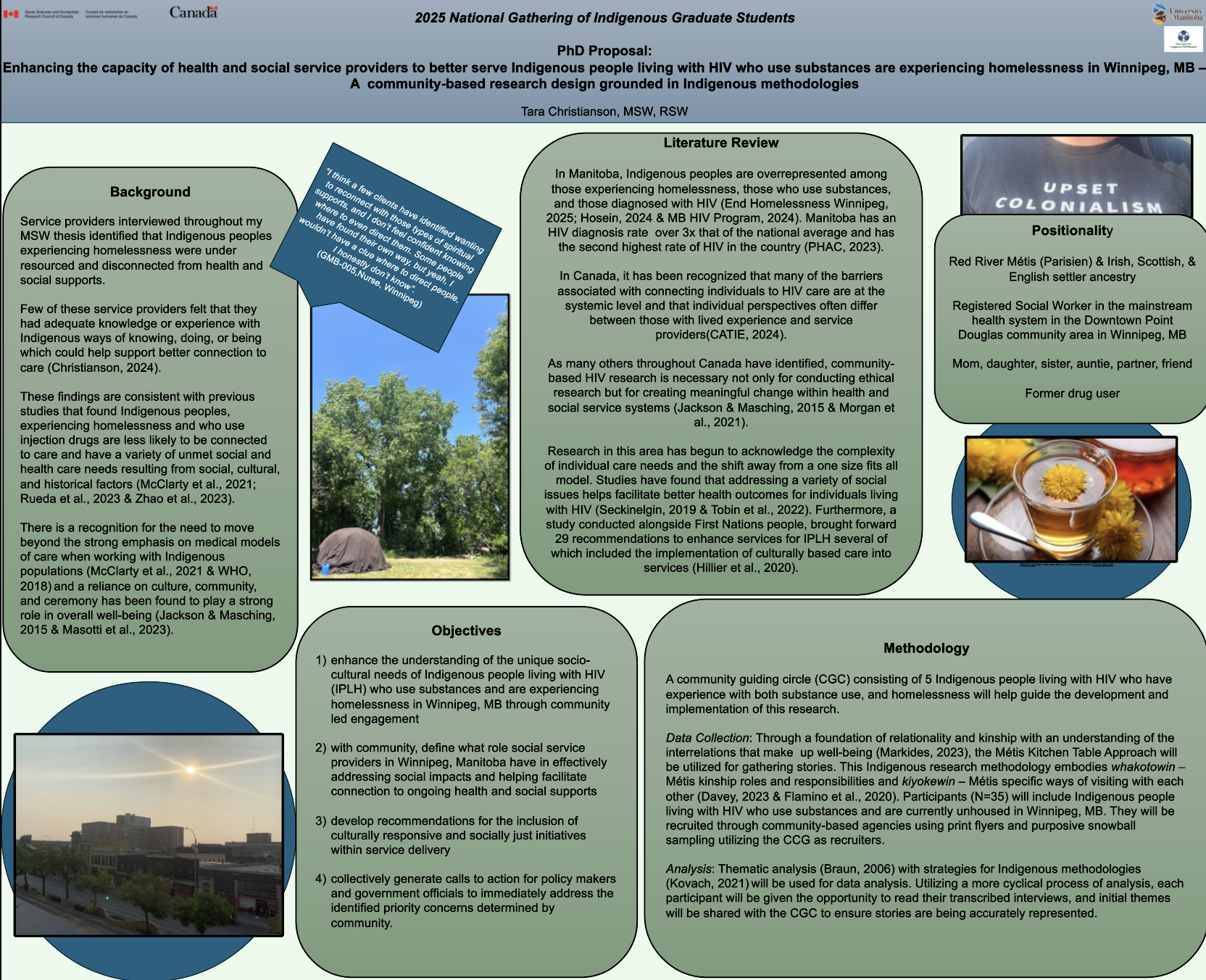
Enhancing the Capacity of Health and Social Service Providers to Better Serve Indigenous People Living with HIV Who Use Substances and Are Experiencing Homelessness in Winnipeg, MB
Tara Christianson, University of Manitoba
About: Explores how health and social service providers can more effectively support Indigenous people living with HIV who use substances and are unhoused in Winnipeg. Building on earlier MSW research, the project draws attention to systemic gaps, limited provider knowledge of Indigenous ways of knowing, and the importance of culturally grounded care. Guided by a community circle of Indigenous people with lived experience, the study uses Métis methodologies, relational interviewing, and thematic analysis to document socio-cultural needs, identify barriers to care, and develop community-led recommendations for more just and responsive service delivery.
Aansaamb atooshkaytaahk: Braiding Métis and Western Knowledges to Prevent Teen Dating Violence in Métis Communities
Tori Wilde; Deinera Exner-Cortens, University of Calgary
About: Draws together Métis ontologies and Western evidence-based frameworks to create a culturally grounded approach to teen dating violence prevention. Through review of existing Indigenous and Western models, the project identifies core elements for Métis-specific programming and weaves them into a seven-strand framework centred on Ethical Space, cultural protocols, relationship building, community expertise, and implementation guidance. Future work involves adapting an established prevention program with Métis youth, caregivers, and community knowledge holders to ensure relevance, kinship alignment, and meaningful cultural adaptation.

Reclaiming Youth Wellness: Indigenous Athletes’ Perspectives on the Wholistic Benefits of Physical Activity
Zoe Kreutzer, University of Calgary
About: Explores Indigenous athletes’ understandings of the wholistic benefits of physical activity, prioritzing relationships to self, community, and land. Guided by Indigenous research methodologies and conversations with young athletes, the study examines how physical activity supports emotional, mental, spiritual, and physical well-being, and how these perspectives differ from dominant Western sport narratives shaped by individualism and colonial histories. The work contributes to strengths-based definitions of physical activity that reflect Indigenous athletes’ voices and supports efforts to reduce barriers, decolonize sport spaces, and recognize Indigenous knowledge as crucial to athlete wellness.
